
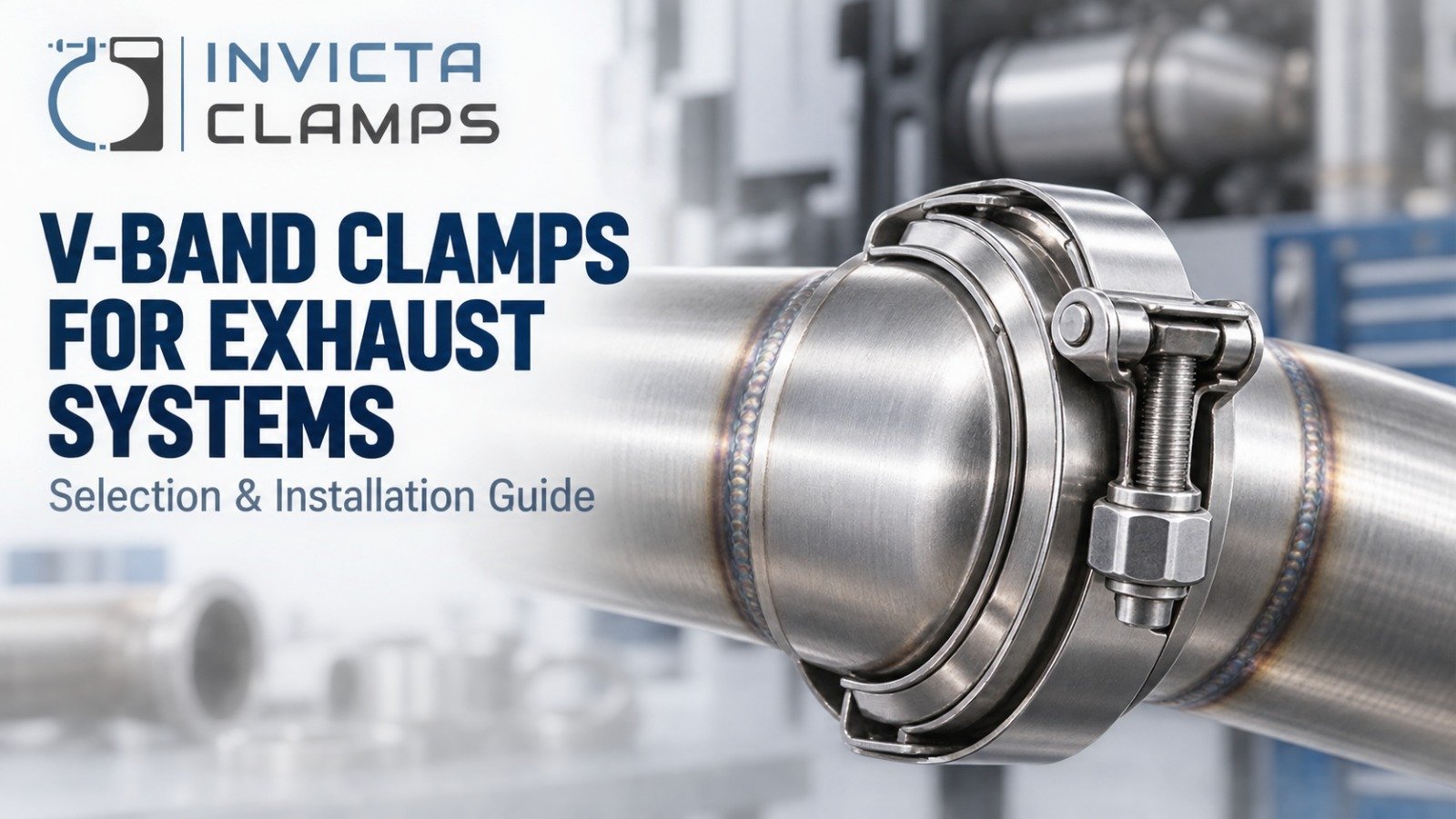
V-band clamps provide a compact and dependable method of joining exhaust pipes, turbocharger connections, filters, housings and other circular components. Their ability to create a secure connection while allowing relatively quick assembly and removal makes them widely used in commercial vehicles, passenger vehicles, construction equipment, agricultural machinery and industrial systems.
However, reliable performance depends on selecting the correct clamp, mating flanges and material for the application. Incorrect sizing, poor flange alignment or unsuitable materials can cause leakage, loosening and premature clamp failure.
This guide explains how V-band clamps work, their principal applications and the factors buyers should consider when specifying them.
What Is a V-Band Clamp?
A V-band clamp is a circular clamping assembly containing a specially formed band with an internal V-shaped profile. This profile engages with two matching flanges positioned at the ends of the components being joined.
As the nut or tightening mechanism is operated, the clamp closes around the flanges. The V-shaped profile converts the applied circumferential force into an axial force that pulls the two mating flanges together.
A typical V-band connection consists of:
• A formed outer band
• V-shaped segments or retainers
• A T-bolt or threaded fastening mechanism
• A nut, trunnion or bridge arrangement
• Two compatible mating flanges
The clamp and flanges must function as one system. The nominal diameter alone is not sufficient to confirm compatibility.
How Do V-Band Clamps Work?
The V-shaped retainer contacts the angled surfaces of both mating flanges. Tightening the clamp draws the flanges together and creates a stable circular joint.
This design distributes clamping force around the connection instead of concentrating it at only one point. When correctly selected and installed, a V-band clamp can provide:
• Uniform circumferential clamping
• Secure flange alignment
• Compact installation
• Quick assembly and removal
• Reduced need for multiple bolts
• Reliable performance under vibration
• Suitability for elevated-temperature applications
The clamp supplies the mechanical holding force. The flange geometry, surface condition and any required gasket or sealing feature determine the sealing performance of the complete joint.
Common Applications of V-Band Clamps
Commercial-Vehicle Exhaust Systems
V-band clamps are commonly used to connect exhaust pipes, silencers, after-treatment units and other exhaust components in trucks, buses and trailers. These applications expose the clamp to heat, vibration, road contamination and repeated thermal expansion.
Turbocharger Connections
Turbocharger systems require compact connections that can withstand vibration and high operating temperatures. V-band clamps are frequently used at turbine inlet and outlet connections because they provide strong retention in a limited installation space.
Diesel Particulate Filters and Catalytic Converters
Modern exhaust after-treatment systems contain components that may require periodic inspection, cleaning or replacement. V-band connections allow technicians to remove and reinstall these assemblies more efficiently than many conventional bolted joints.
Agricultural and Construction Equipment
Tractors, harvesters, excavators, loaders and other off-highway machines operate in dusty and highly vibrational environments. Correctly specified V-band clamps help retain exhaust and engine-related connections under demanding working conditions.
Industrial Equipment
V-band connections are also used in pumps, filtration equipment, process lines, dust-collection systems and industrial machinery where circular components require secure but removable connections.
Benefits of V-Band Clamps
Compact Construction
A V-band connection generally requires less installation space than a conventional multi-bolt flange. This is particularly useful in crowded engine compartments and exhaust-system layouts.
Faster Assembly
The connection normally uses one primary tightening mechanism. This can reduce installation and servicing time compared with flange joints containing several separate bolts.
Even Clamping Force
The circular band distributes force around the mating flanges. This helps maintain alignment and reduces the possibility of uneven loading when the system has been designed and installed correctly.
Serviceability
V-band clamps allow exhaust sections, filters and housings to be disconnected for maintenance. This is valuable for systems containing serviceable components.
Resistance to Vibration
A properly designed V-band assembly can maintain a secure connection in applications exposed to engine vibration and vehicle movement. The clamp must still be tightened to the specified torque and inspected at the recommended service intervals.
How to Select the Correct V-Band Clamp
1. Confirm the Mating-Flange Profile
V-band clamps are designed to engage with particular flange shapes and angles. Two clamps with the same nominal diameter may have different internal profiles and may not be interchangeable.
Confirm the following dimensions:
• Flange outside diameter
• Flange angle
• Flange thickness
• Clamp internal profile
• Band width
• Closed operating diameter
• Bolt diameter and length
Whenever possible, provide the clamp manufacturer with an approved drawing of the complete joint.
2. Measure the Diameter Correctly
Do not select a V-band clamp based only on the outside diameter of the exhaust pipe. The clamp engages with the flanges, so the controlling dimensions normally relate to the flange geometry and the clamp’s closed diameter.
Measurements should be taken with suitable calibrated equipment. A physical sample can also help when drawings are unavailable, but the final dimensions should be documented before production.
3. Consider Operating Temperature
Exhaust-system temperatures can vary significantly depending on the engine, installation position and duty cycle. A clamp fitted near a turbocharger or after-treatment device may experience much higher temperatures than one installed further downstream.
High temperatures can affect:
• Material strength
• Nut performance
• Surface coatings
• Thermal expansion
• Resistance to oxidation
• Long-term tightening force
The maximum continuous and peak operating temperatures should therefore be stated during product selection.
4. Select the Appropriate Material
Material selection depends on temperature, corrosion exposure, strength and cost requirements.
Common options include:
Carbon steel: Suitable for cost-sensitive applications where temperature and corrosion conditions permit. An appropriate protective coating may be required.
Stainless steel 304: Provides good corrosion resistance and is widely used for automotive, exhaust and industrial applications.
Stainless steel 316: Offers improved resistance in marine, chemical and highly corrosive environments.
Heat-resistant stainless-steel grades: May be required for high-temperature exhaust applications. The correct grade should be selected according to the actual thermal and mechanical requirements.
The clamp band, retainer, bolt and nut should be reviewed as a complete assembly because different components may experience different loads and temperatures.
5. Evaluate Corrosion Exposure
Commercial vehicles may encounter rain, road salt, mud, cleaning chemicals and extended outdoor exposure. Corrosion can reduce section thickness, damage threads and make future removal difficult.
Specify the required corrosion protection clearly, including:
• Material grade
• Coating type
• Coating thickness
• Salt-spray requirement
• Passivation requirements
• Restrictions on hazardous substances
• Appearance or colour requirements
The coating must also remain suitable for the expected operating temperature.
6. Confirm the Required Tightening System
Different V-band clamps may use standard nuts, prevailing-torque nuts, locknuts or other fastening arrangements. The selected system must suit the operating temperature and vibration level.
For example, locking elements containing polymer inserts may not be appropriate for very high-temperature locations. All-metal locking solutions may be considered where the application demands greater temperature resistance.
The final selection should follow the approved technical specification.
Correct Installation Procedure
Before installation, inspect the clamp and both mating flanges for damage, distortion, contamination and corrosion.
Follow these general steps:
1. Align the two mating components without forcing them into position.
2. Confirm that the flange faces are clean and correctly seated.
3. Position the V-band clamp evenly around both flanges.
4. Ensure that the clamp profile engages fully with the flange surfaces.
5. Tighten the fastener gradually while checking alignment.
6. Tap around the clamp lightly, when permitted by the installation procedure, to help the assembly seat evenly.
7. Tighten the fastener to the specified torque.
8. Inspect the complete circumference for uneven seating or gaps.
9. Perform any required leakage or functional test.
Always follow the vehicle, equipment or joint manufacturer’s specified torque and installation procedure.
Common Installation Mistakes
Using an Incorrect Flange Profile
A clamp that does not match the mating flanges may appear to fit but can create uneven contact and insufficient axial force.
Installing Misaligned Components
The clamp should retain an aligned joint. It should not be used to pull badly misaligned pipes or housings into position.
Overtightening
Excessive torque can deform the clamp, damage the flange, stretch the bolt or reduce the service life of the connection.
Undertightening
Insufficient torque can allow movement, leakage and eventual loosening under vibration.
Reusing a Damaged Clamp
A clamp showing distortion, cracking, damaged threads, severe corrosion or permanent stretching should be replaced.
Mixing Unapproved Components
Using a clamp, flange, bolt or nut from incompatible systems can affect fitment and joint performance. Components should be validated together before use.
Information to Provide When Requesting a Quotation
To receive an accurate technical and commercial offer, provide:
• Application and installation location
• Required clamp diameter
• Flange drawing or physical sample
• Band and retainer dimensions
• Material grade
• Minimum and maximum temperature
• Corrosion-protection requirement
• Required tightening torque
• Annual quantity and order quantity
• Inspection, testing and documentation requirements
• Packaging and labelling requirements
Detailed application information reduces the risk of incorrect selection and speeds up product development.
Custom V-Band Clamp Development
Standard V-band clamps may not suit every flange, temperature range or installation space. Custom clamps can be developed from customer drawings, approved samples, mating-component dimensions or application requirements.
Development may include:
• Modified band widths and profiles
• Different diameters
• Alternative bolt and nut arrangements
• Stainless-steel and heat-resistant materials
• Application-specific surface finishes
• Prototype and initial-sample production
• Dimensional reports and inspection documentation
• Custom packaging and private labelling
Customers should validate custom assemblies under actual operating conditions before approving serial production.
Conclusion
V-band clamps offer a compact, serviceable and dependable method of connecting exhaust and other circular components. Their performance depends on more than nominal diameter. Flange geometry, material, temperature, corrosion exposure, tightening system and installation method must all be considered.
Invicta Clamps supplies standard and customised V-band clamps for commercial vehicles, automotive exhaust systems, agricultural machinery, construction equipment and industrial applications. Products can be developed according to drawings, samples, OEM references and application requirements.
To discuss a V-band clamp requirement, send us your drawings, dimensions, material specification, operating temperature and estimated quantities.
Frequently Asked Questions
Are all V-band clamps with the same diameter interchangeable?
No. Clamps with similar diameters may have different flange angles, retainer profiles, band widths and fastening systems. Confirm the complete flange and clamp geometry before ordering.
Can V-band clamps be used at high temperatures?
Yes, provided the clamp material, nut, bolt and any surface treatment are suitable for the specified continuous and peak temperatures.
Do V-band clamps require a gasket?
Some V-band joints use a gasket, while others rely on accurately designed mating flanges or another sealing feature. Follow the approved joint design.
Can a V-band clamp be reused?
Reuse depends on the application and the clamp’s condition. Do not reuse a clamp that is distorted, cracked, severely corroded or has damaged threads. Safety-critical applications may require replacement after removal.
What information is required for a custom V-band clamp?
Provide the flange drawing, operating diameter, profile dimensions, material, temperature range, corrosion requirement, tightening arrangement and expected order quantity.