Selecting the correct hose clamp is not simply a matter of choosing a clamp that appears to fit. The clamp must have the correct size range, provide sufficient clamping force, and suit the hose, fitting, temperature, vibration, and operating environment.
A clamp that is too large may not provide sufficient sealing force, while a clamp that is too small can be difficult to install and may damage the hose.
The good news is that selecting the right clamp starts with one simple measurement: the outside diameter of the hose and fitting assembly.
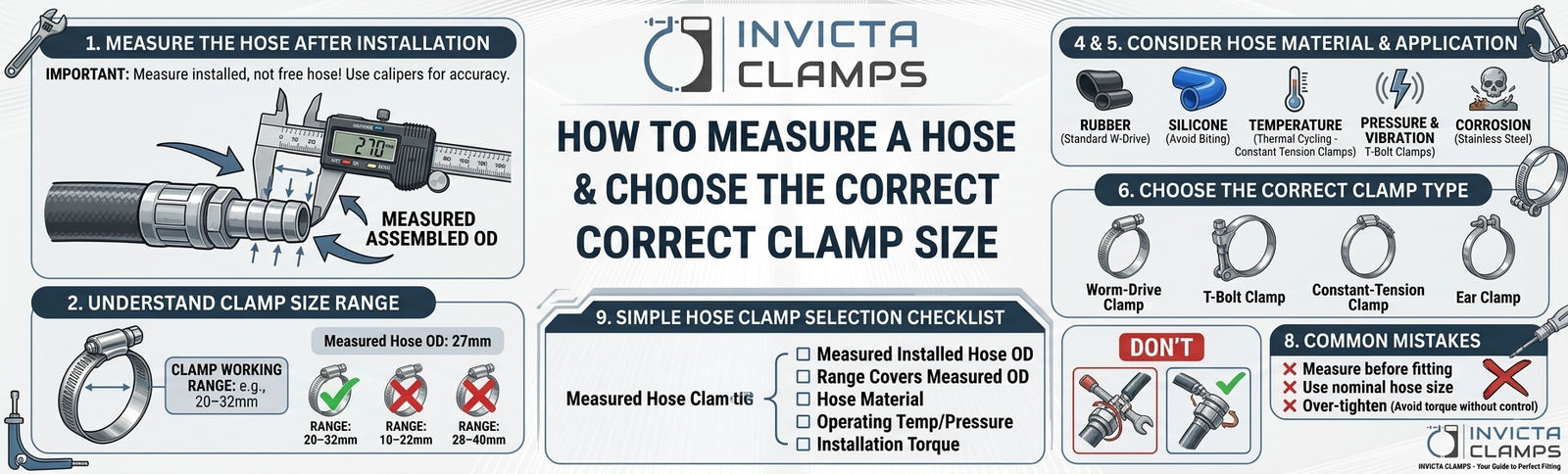
1. Measure the Hose After Installation
One of the most common mistakes when selecting a hose clamp is measuring the hose before it is fitted onto the connection.
The hose can expand when installed over a barb, pipe or fitting. Therefore, the relevant measurement is generally the outside diameter (OD) of the assembled connection, rather than the hose’s free-state diameter.
Correct method:
Install the hose fully onto the fitting.
Position the hose exactly where it will sit during operation.
Measure the outside diameter of the hose at the clamp location.
Take the measurement at several points if possible.
Use the largest relevant measurement when determining the clamp size.
For greater accuracy, use a vernier caliper rather than a tape measure.
2. Understand Clamp Size Range
Hose clamps are manufactured with a specific adjustment range.
For example, a clamp may have a working range of:
20–32 mm
This means the clamp is designed to accommodate hose assemblies within that approximate diameter range.
Your measured hose OD should sit comfortably within the clamp’s working range rather than being right at either extreme.
Example
If your assembled hose measures:
27 mm OD
A clamp with a range of:
20–32 mm
would generally be a much more appropriate starting point than a clamp with a range of:
10–22 mm
or one with a range of:
28–40 mm.
The objective is to select a clamp that provides adequate adjustment while maintaining the intended clamping performance.
3. Don’t Select a Clamp Based Only on Nominal Hose Size
A hose labelled as 25 mm does not necessarily mean that you should purchase a 25 mm clamp.
Hose dimensions can vary depending on:
Hose construction
Wall thickness
Reinforcement
Manufacturer
Fitting dimensions
Hose material
Application
The same nominal hose size can therefore have different actual outside diameters.
Always verify the actual assembled OD before finalising the clamp.
4. Consider the Hose Material
The hose material also influences clamp selection.
A rigid rubber hose can behave very differently from a soft silicone or thermoplastic hose.
For softer hose materials, excessive localised pressure can damage the hose or cause the clamp to bite into the material. In such applications, the clamp design and band configuration become particularly important.
For example:
Rubber hoses: Standard worm-drive clamps are commonly suitable for many applications.
Silicone hoses: A wider or application-specific clamp may be preferable.
Soft-wall hoses: Avoid excessive tightening and concentrated loading.
Heavy-duty hoses: T-bolt or other high-performance clamp designs may be more appropriate.
The correct choice therefore depends on more than diameter alone.
5. Consider the Application
Before selecting a clamp, consider what the hose is being used for.
Important factors include:
Temperature
Hoses can expand and contract as temperatures change.
For applications involving significant thermal cycling, constant-tension or spring-loaded clamps can help maintain clamping pressure as the hose dimensions change.
Vibration
Automotive and industrial applications can expose hose connections to continuous vibration.
For high-vibration applications, a clamp designed for higher clamping loads or more secure retention may be preferable.
Pressure
Higher-pressure applications may require a more robust clamp design.
T-bolt clamps, for example, are commonly used where higher clamping force is required, including certain automotive and industrial applications.
Corrosion
The surrounding environment should also influence material selection.
For outdoor, marine, chemical or otherwise corrosive environments, stainless steel may provide advantages over coated carbon steel.
6. Choose the Correct Clamp Type
Once the diameter and application have been established, the next step is selecting the appropriate clamp design.
Worm-Drive Clamps
Worm-drive clamps are adjustable and widely used for automotive, industrial, plumbing and general hose applications.
They are particularly useful when:
The hose diameter varies slightly
The connection needs to be removable
Adjustment is required
A general-purpose solution is needed
T-Bolt Clamps
T-bolt clamps use a bolt and nut rather than a conventional worm mechanism.
They are commonly selected for:
Large-diameter hoses
High-vibration applications
Heavy-duty connections
Applications requiring high clamping force
Constant-Tension Clamps
Constant-tension clamps incorporate a spring mechanism that helps compensate for changes in hose diameter caused by temperature fluctuations.
They can be particularly useful in automotive cooling and other applications involving repeated thermal cycling.
Ear Clamps
Ear clamps are generally designed for permanent or semi-permanent installations where a consistent crimped connection is required.
They are frequently used in automotive and industrial assembly applications.
7. Avoid Over-Tightening
A common misconception is that tighter always means better.
It doesn’t.
Over-tightening can damage both the clamp and the hose. It can deform the hose, create excessive local pressure, damage the clamp mechanism, and potentially result in leakage or premature failure.
Manufacturers should always follow the specified installation torque for the particular clamp. Automotive service guidance also warns that exceeding the recommended torque can damage the clamp or hose without producing a proportional improvement in sealing performance.
The objective is controlled clamping force—not maximum tightening force.
8. Common Hose Clamp Sizing Mistakes
❌ Measuring the hose before fitting it
The assembled OD can be different from the free hose diameter.
❌ Choosing a clamp exactly equal to the nominal hose size
Nominal hose size does not necessarily correspond to the required clamp diameter.
❌ Selecting a clamp that is too close to its minimum range
This can leave insufficient adjustment and make installation difficult.
❌ Selecting an excessively large clamp
The clamp may not achieve the required compression or sealing performance.
❌ Ignoring hose material
Soft silicone and rubber hoses may require different clamping strategies.
❌ Tightening without torque control
Excessive tightening can damage the hose or clamp.
9. A Simple Hose Clamp Selection Checklist
Before ordering your clamps, confirm:
→ Hose outside diameter measured after installation
→ Clamp adjustment range covers the measured OD
→ Correct clamp width selected
→ Hose material considered
→ Operating temperature considered
→ Operating pressure considered
→ Vibration level considered
→ Corrosion environment considered
→ Correct clamp material selected
→ Recommended installation torque available
Final Thoughts
Choosing the right hose clamp begins with an accurate measurement.
Rather than selecting a clamp based solely on the nominal hose diameter, measure the actual outside diameter of the assembled hose and fitting, select a clamp whose adjustment range comfortably covers that measurement, and then consider the material and operating conditions.
For simple general-purpose applications, a conventional worm-drive clamp may be sufficient. For high-vibration, high-load or temperature-cycling applications, however, a T-bolt, constant-tension or application-specific clamp may provide a better solution.
At Invicta Clamps, we manufacture a wide range of hose clamps and industrial clamping solutions for automotive, exhaust, industrial and other applications. Selecting the correct clamp design, material and size is essential for achieving reliable long-term performance.