
A truck’s cooling system experiences repeated changes in temperature and pressure throughout its working day. From a cold start to sustained highway operation, hoses and connections must maintain a reliable seal as operating conditions change.
This is where constant tension clamps can offer an advantage. Their spring action helps accommodate dimensional changes in the connection, making them particularly relevant to demanding truck, bus and heavy-equipment applications.
What Is a Constant Tension Clamp?
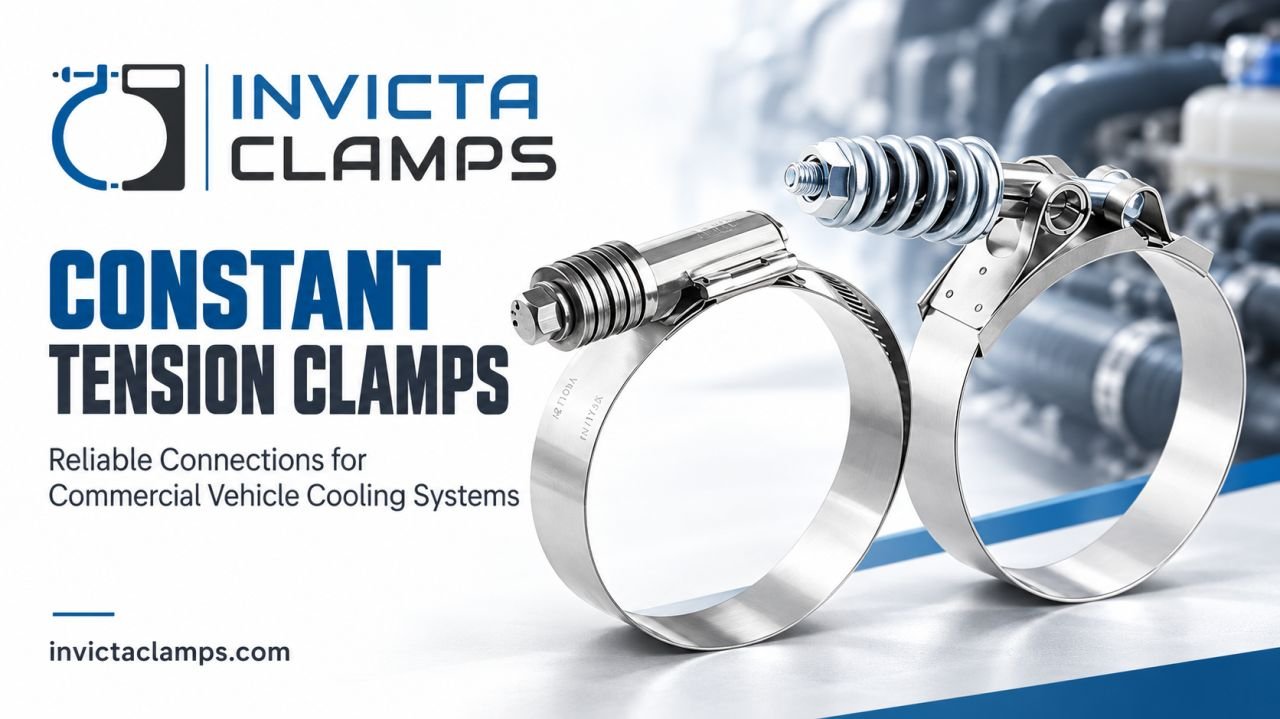
A constant tension clamp incorporates a spring mechanism that allows it to respond to changes in the hose assembly’s diameter. Depending on the design, this may involve a spring steel band, spring washers or another spring-loaded arrangement.
The purpose is to help maintain clamping force as the connection expands, contracts or settles during service. Different designs provide different adjustment ranges and force characteristics, so they should not be treated as interchangeable.
Why Temperature Changes Affect Hose Connections
A hose connection brings together components with different physical properties. The flexible hose, metal fitting and clamp do not necessarily expand or contract by the same amount as temperatures change.
The hose material can also relax under sustained compression. Over time, these changes can affect the contact pressure that supports the seal.
A clamp tightened during assembly must therefore perform beyond the initial installation. Its behaviour during repeated heating and cooling is an important part of connection reliability.
How Spring Compensation Helps
A suitable constant tension clamp provides a degree of movement while continuing to apply force around the hose.
As the assembly changes diameter, the spring mechanism responds within its designed working range. This helps accommodate thermal movement and hose relaxation.
However, spring compensation has limits. It cannot correct an unsuitable hose, damaged fitting, incorrect installation or an application operating beyond the clamp’s capabilities.
Where Are Constant Tension Clamps Used?
Constant tension designs are used in commercial vehicle applications such as:
• Engine coolant and radiator hose connections.
• Heater hose assemblies.
• Selected intake and charge-air connections.
• Cooling circuits on buses, agricultural machinery and construction equipment.
The appropriate design depends on the specific connection. A small coolant hose and a large pressurised charge-air hose may require very different clamp constructions.
Spring Band and Spring-Loaded Worm Drive Designs
Two common approaches are spring band clamps and spring-loaded worm drive clamps.
Spring band clamps use the elasticity of a formed steel band to apply force. They are designed for a defined working diameter range and typically require suitable installation tools.
Spring-loaded worm drive clamps combine screw adjustment with a spring mechanism. They offer an adjustable clamping range while providing compensation for dimensional changes.
Some heavy-duty assemblies use spring-loaded T-bolt designs. Selection should follow the hose system requirements and the clamp manufacturer’s specifications.
Installation Still Determines Performance
Even a suitable clamp needs correct installation.
The clamp must sit in the specified position on the fitting, with the hose fully seated and the band aligned correctly. Screw-operated designs must be tightened to the specified installation torque using an appropriate tool.
There is no universal tightening torque for all constant tension clamps. The correct value depends on the clamp design, size and hose assembly.
Constant tension also does not automatically mean maintenance-free. Inspection and any retightening requirements should follow the vehicle or equipment manufacturer’s instructions.
What Should Buyers Specify?
For OEM purchasing, aftermarket development or replacement sourcing, provide more than the nominal hose diameter.
Useful application details include:
• Hose outside diameter when fitted.
• Hose material and wall thickness.
• Fitting dimensions and retaining-bead geometry.
• Operating temperature and pressure ranges.
• Available installation space.
• Corrosion exposure.
• Required installation method and validation tests.
These details help establish whether the clamp can maintain an effective seal throughout the intended operating cycle.
Validate the Complete Connection
A clamp should be evaluated as part of the complete hose-and-fitting assembly. Relevant checks may include leakage, hose retention, thermal cycling, pressure cycling and corrosion resistance.
A successful room-temperature assembly check provides useful information, but repeated operating cycles help establish how the connection performs in service.
Discuss Your Application with Invicta Clamps
Invicta Clamps supplies constant torque worm drive clamps, spring band clamps and other fastening solutions for commercial vehicle and industrial applications.
For a new requirement, share your drawing, hose details and operating conditions with our team. We can review the application and discuss a suitable clamp design for evaluation.
Contact Invicta Clamps to discuss your commercial vehicle hose connection requirements.