
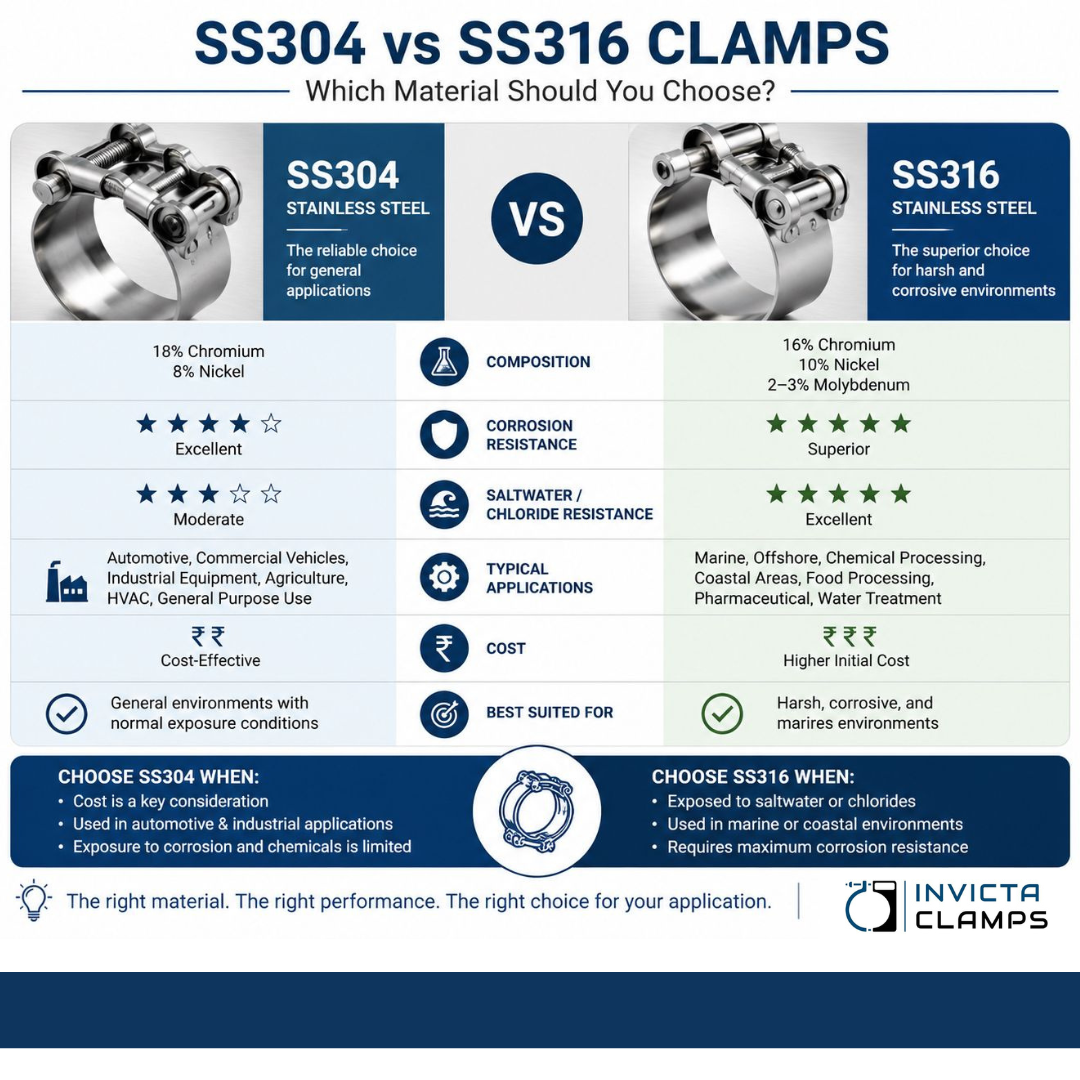
Selecting the correct material is one of the most important decisions when specifying a clamp. While both SS304 and SS316 stainless steel offer excellent corrosion resistance and durability, understanding their differences can help ensure optimal performance, longer service life, and lower maintenance costs.
This guide compares SS304 and SS316 clamps and explains which material is best suited for various applications.
Understanding Stainless Steel Clamps
Stainless steel clamps are widely used in automotive, industrial, marine, agricultural, food processing, and chemical applications due to their strength, corrosion resistance, and long-term reliability.
Among the various stainless steel grades available, SS304 and SS316 are the most commonly used.
Although they appear similar, their chemical composition and performance characteristics differ significantly in certain environments.
What is SS304 Stainless Steel?
SS304 is the most widely used stainless steel grade worldwide.
It typically contains:
Approximately 18% Chromium
Approximately 8% Nickel
This composition provides excellent corrosion resistance, good strength, and attractive appearance at a competitive cost.
Advantages of SS304 Clamps
Excellent general corrosion resistance
Good strength and durability
Suitable for most automotive applications
Cost-effective compared to SS316
Good resistance to oxidation and weathering
Widely available
Typical Applications
SS304 clamps are commonly used in:
Automotive exhaust systems
Air intake systems
Commercial vehicles
Industrial machinery
Agricultural equipment
HVAC systems
General industrial applications
For most indoor and outdoor applications, SS304 provides an excellent balance of performance and cost.
What is SS316 Stainless Steel?
SS316 contains additional molybdenum, typically around 2-3%, which significantly improves its resistance to corrosion, particularly in aggressive environments.
Typical composition:
Approximately 16% Chromium
Approximately 10% Nickel
Approximately 2-3% Molybdenum
The addition of molybdenum makes SS316 especially resistant to chlorides, saltwater, and certain chemicals.
Advantages of SS316 Clamps
Superior corrosion resistance
Excellent resistance to chlorides and salt spray
Better performance in marine environments
Improved resistance to chemical exposure
Longer service life in harsh conditions
Typical Applications
SS316 clamps are commonly used in:
Marine applications
Offshore equipment
Chemical processing plants
Coastal environments
Food processing equipment
Pharmaceutical manufacturing
Water treatment systems
SS304 vs SS316: Key Differences
| Property | SS304 | SS316 |
|---|---|---|
| Corrosion Resistance | Excellent | Superior |
| Saltwater Resistance | Moderate | Excellent |
| Chemical Resistance | Good | Excellent |
| Cost | Lower | Higher |
| Automotive Applications | Excellent | Excellent |
| Marine Applications | Acceptable | Recommended |
| General Industrial Use | Excellent | Excellent |
Which Material Should You Choose?
The correct choice depends primarily on the operating environment.
Choose SS304 When:
Cost is an important consideration
The application is automotive or industrial
Exposure to corrosive chemicals is limited
The environment is not coastal or marine
General-purpose corrosion resistance is sufficient
For the majority of automotive, commercial vehicle, and industrial applications, SS304 is often the preferred choice due to its excellent performance-to-cost ratio.
Choose SS316 When:
The application is exposed to saltwater
The environment contains chlorides
Chemical exposure is significant
Maximum corrosion resistance is required
Long-term durability is critical
In aggressive environments, the additional investment in SS316 can significantly reduce maintenance and replacement costs over the product’s lifetime.
Consider Total Lifecycle Cost
While SS316 typically has a higher initial cost, it may provide lower total ownership costs in demanding environments.
Factors to consider include:
Replacement frequency
Maintenance requirements
Downtime costs
Environmental conditions
Expected service life
Selecting the correct material from the start can help avoid premature failures and costly maintenance.
Material Selection for Clamp Applications
Different applications often require different material grades.
Automotive & Commercial Vehicles
Recommended Material:
SS304
Provides excellent durability and corrosion resistance for most operating conditions.
Marine Applications
Recommended Material:
SS316
Superior resistance to saltwater corrosion and marine environments.
Industrial Equipment
Recommended Material:
SS304 or SS316
Selection depends on environmental conditions and chemical exposure.
Chemical Processing
Recommended Material:
SS316
Offers enhanced protection against aggressive chemicals and corrosive environments.
Conclusion
Both SS304 and SS316 stainless steel clamps provide excellent strength, durability, and corrosion resistance. The best choice depends on the operating environment and performance requirements.
For most automotive, industrial, and commercial applications, SS304 offers outstanding value and reliable performance.
For marine, coastal, chemical, and highly corrosive environments, SS316 provides superior protection and longer service life.
At Invicta Clamps, we manufacture a wide range of stainless steel clamping solutions in both SS304 and SS316 grades. Our engineering team can help you select the most suitable material for your specific application.
Contact us today to discuss your requirements or request a quotation.